Preface
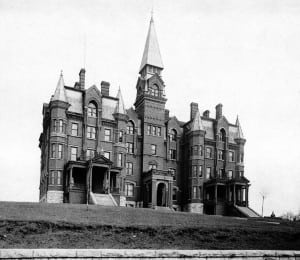
Cliff Edge College had been a venerable educational institution before it had succumbed to delusions of grandeur and become Cliff Edge University. That had happened sometime in the ‘90s during the educational bubble when colleges and universities began to swell their administrative ranks with castoffs from the business world who saw them as lambs ripe for slaughtering for their own individual enrichment. Cliff Edge had been preparing its graduates for careers in various technical fields since the late nineteenth century. That’s where it really excelled. It trained scientists and engineers, secretaries, and even nurses and actually had an art school of some renown. It recruited students mostly locally and had a tightly-knit community of alumni (and alumnae) and close connections with many businesses in the Tri-State region of Southern Ohio, Indiana, and Northern Kentucky. It thrived for close to a century despite relative national obscurity and even produced a few captains of industry and members of Congress.
It began to shrink oh so gradually, however, in the ‘70s and ’80s, partly through complacency and partly through shifting demographics that meant a dwindling pool of young people applying for college. Class sizes dwindled. Tuition income went down. Classrooms increasingly sat empty, until, finally, dedicated trustees, sleeping, or so it seemed for decades, sprang into action like Holger Dansker to save Cliff Edge from the specter of imminent closure. They launched a national search to replace the aging president, Whitman Whitehair, with someone younger and more dynamic, someone, they agreed, who had a business background and could resurrect Cliff Edge and make it great again.
There had been a number of promising candidates. Carl Climber, who’d been head of PR for a mid-size Oklahoma oil company and onetime state representative, had been the universal favorite, but he’d parlayed his offer to lead Cliff Edge into an even better offer to lead a higher-ranked university farther East before his appointment had even been publicly announced. Lawrence Libertine, the second choice, had everything it took to turn Cliff Edge around, everything, it turned out except discretion. He was at Cliff Edge for less than a year when he was ousted by the trustees as the result of a scandal that involved his sending sexually explicit texts to female members of his staff.
Felix Fraudster had been the third choice. He’s made a fortune, or so he claimed, in real estate in Texas, and then started his own educational software company one of the products of which was an online learning platform that he agreed to sell to Cliff Edge at a deeply discounted price if he were hired as president. That none of the trustees noticed the conflict of interest in such an agreement was the first failure of leadership in a saga marked by multiple failures of leadership.
This is the sad story of the decline of a once proud educational institution and in particular, of the demise of a deeply dysfunctional academic department brought on by a staggeringly incompetent dean, the eponymous “Debbie,” and the collection of imbecilic and ill-willed pseudo-intellectuals who comprised the faculty.
Get new content delivered directly to your inbox.

